How RFID Monitoring Works in Garbage Collection Trucks
Introduction
In modern waste management, IoT and RFID technologies play a crucial role in improving operational efficiency, traceability, and service quality.
By integrating RFID systems into garbage trucks, it becomes possible to automatically identify waste containers, classify materials, and transmit data in real time to a central backoffice system.
System Architecture
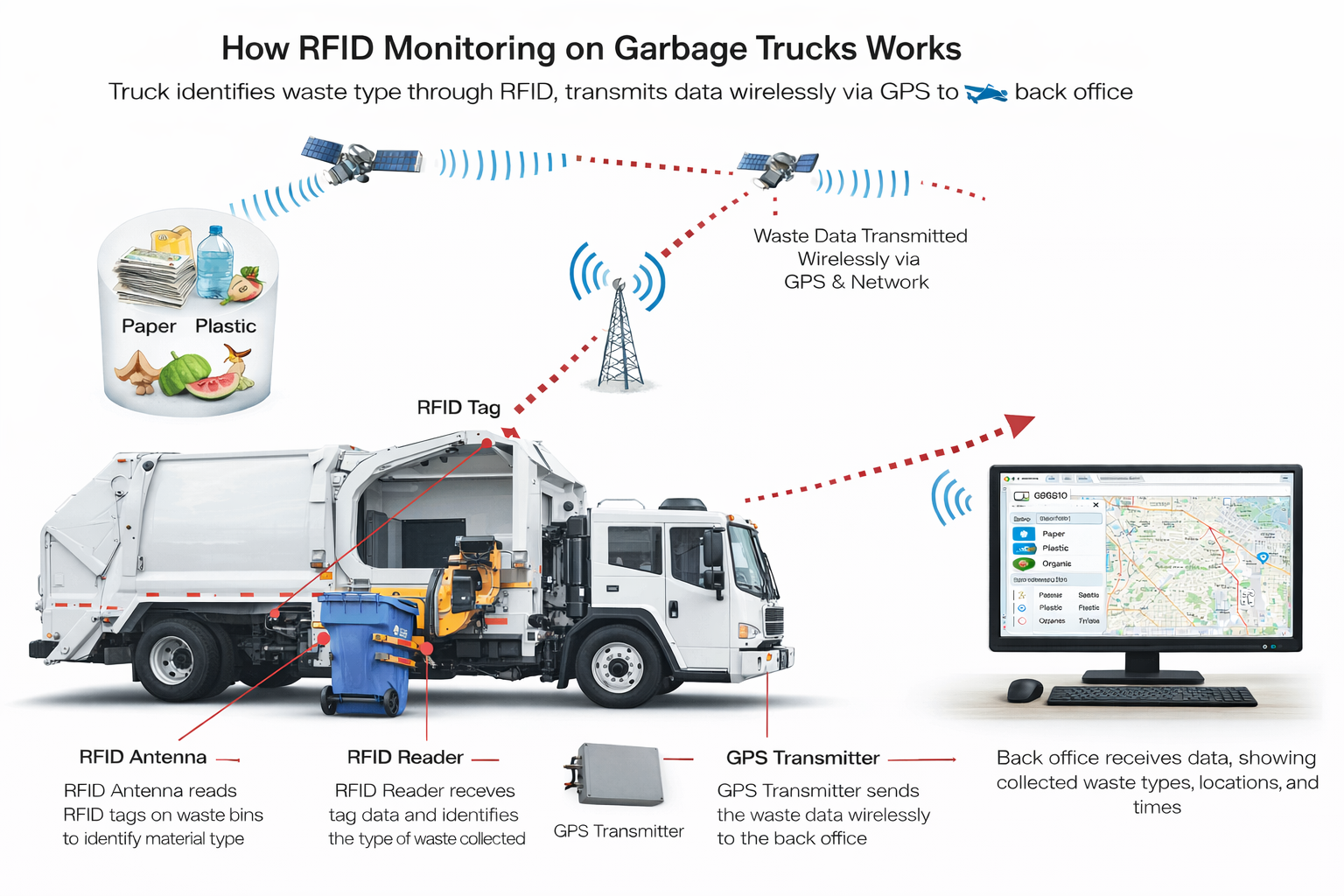
An RFID-based waste collection system consists of four main components:
1. RFID Tags
Each container is equipped with a unique RFID tag containing:
- Container ID
- Association with user or area
- Waste type (organic, plastic, paper, residual)
These tags are passive and activated by the reader’s electromagnetic field.
2. RFID Antenna on Truck
The truck is equipped with one or more RFID antennas, typically positioned near the lifting mechanism.
Function:
- Activate the RFID tag during collection
- Read data contactlessly
- Ensure reliable readings in harsh environments
3. RFID Reader and Onboard Unit
The antenna connects to an RFID reader, integrated with an onboard computer.
This unit:
- Decodes tag data
- Associates events with timestamp and location
- Integrates additional sensors (e.g., lift sensor)
This is where the collection event is validated.
4. GPS & Connectivity
The truck includes:
A GPS module Connectivity (4G/5G/LTE or satellite)
Function:
- Transmit collected data to the central system
- Enable real-time monitoring
- Track routes and operations
Operational Workflow
The full process works as follows:
- The truck approaches a waste bin
- The lifting system triggers RFID reading
- The antenna reads the bin’s RFID tag
- The system identifies the waste type
- The system records:
- Container ID
- Waste type
- Timestamp
- GPS position
- Data is transmitted to the backoffice
- The central system processes and displays the data
Backoffice & Analytics
In the central platform, data is used for:
- Full traceability of collection activities
- Route optimization
- Operational performance analysis
- Pay-As-You-Throw (PAYT) models
- Anomaly and missed collection detection
Dashboards typically include map visualization, reporting tools, and integration with enterprise systems.
Key Benefits
Operational Efficiency
- Faster collection cycles
- Process automation
Transparency and Control
- Real-time monitoring
- Full audit trail
Cost Optimization
- Reduced operational costs
- Enabling PAYT models
Sustainability
- Better waste management
- Increased recycling rates