AI Accident Reconstruction
In the high-stakes sectors of car rental and commercial fleet management, there is a critical moment that every operator dreads: receiving an accident alert. In that exact millisecond, complex questions arise: What is the extent of the damage? Who is at fault? Can the vehicle safely continue its journey?
Until recently, the answers relied on rushed paperwork, conflicting driver statements, or complex, raw telemetry logs that took days for specialized engineers to interpret.
Today, Mative is redefining industry standards. We have developed an intelligent architecture capable of transforming invisible vehicle vibrations into a crystal-clear, objective impact report available in real time.
Behind the Scenes: How Mative Technology Works
Traditional telematics systems rely purely on fixed deceleration thresholds (G-force). This approach frequently generates false positives—hitting a deep pothole or speeding over a speed bump can trigger false alarms, overwhelming fleet managers.
The Mative Cloud ecosystem operates on a radically superior level, structured across three key phases:
1. The Challenge: Decoding Accelerometer Noise
Every GPS tracking device installed inside a vehicle is equipped with a triaxial accelerometer. This sensor constantly records acceleration forces along three vector axes:
- X-Axis: Longitudinal acceleration (sudden braking and harsh acceleration).
- Y-Axis: Lateral acceleration (sharp cornering, swerving, or sideways impacts).
- Z-Axis: Vertical acceleration (potholes, speed bumps, or road surface changes).
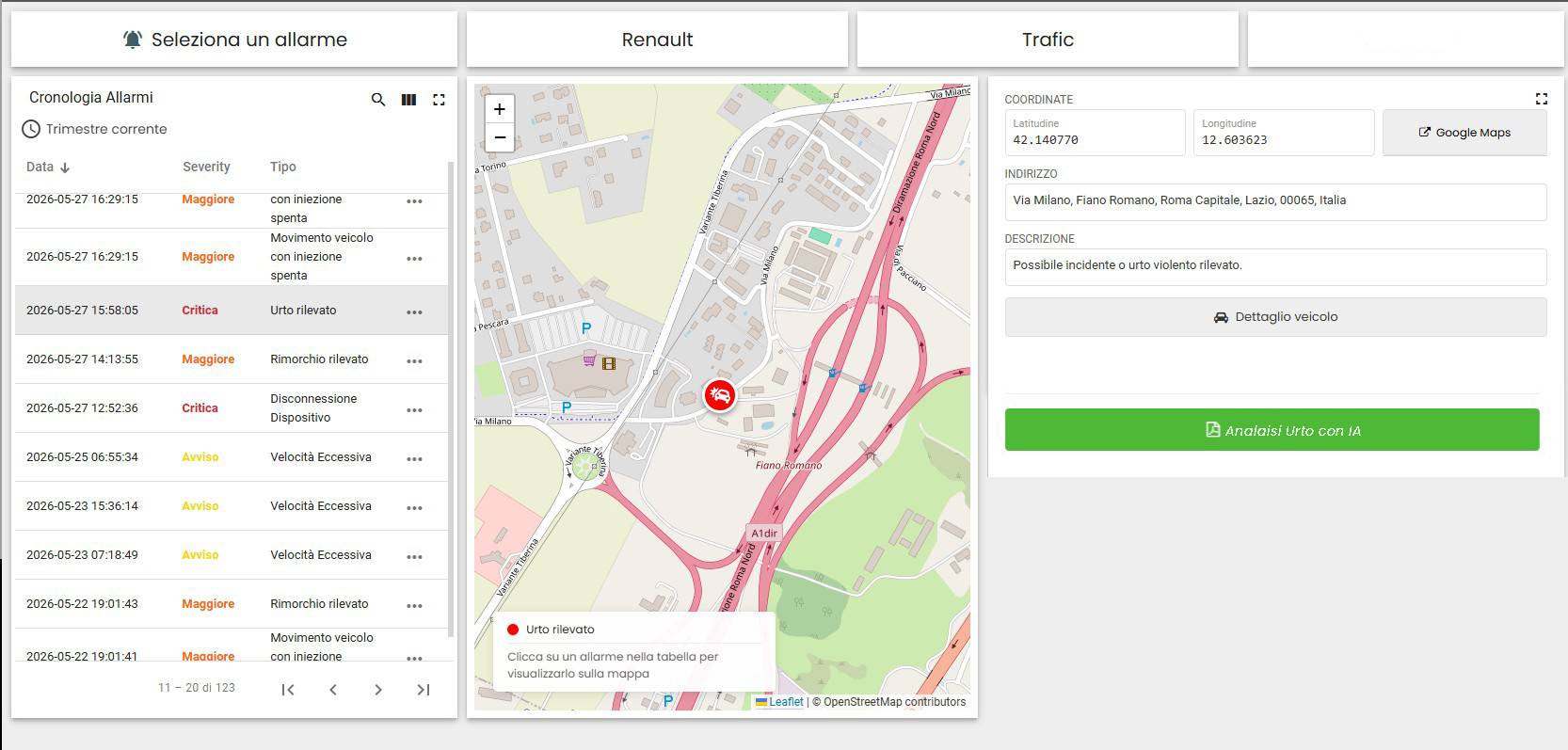
When a collision occurs, the device sends an "impact alert" to the cloud platform, accompanied by a string of raw G-force data. To the human eye, this data is just an unreadable jumble of numbers and erratic graphs. Mative Cloud intervenes by isolating a targeted ±5-minute time window around the event to capture the exact pre- and post-impact kinematics.
2. The Mathematical Brain: Machine Learning for Localization
This is where our Machine Learning model comes into play: a Random Forest Classifier built with 100 parallel estimators and trained on vast datasets of crash kinematics. The core strength of the model lies in its Feature Engineering stage. Instead of just looking at an isolated G-force peak, Mative's pipeline extracts advanced mathematical indicators from the signal: net magnitude, continuous power (RMS), wave integrals, longitudinal-to-lateral force ratios, and the estimated angle of impact.
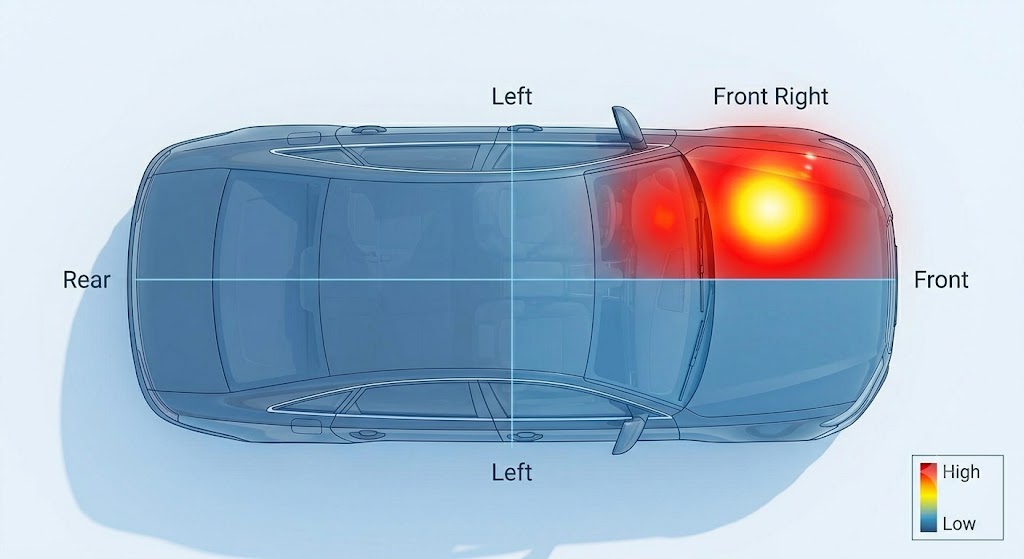
By analyzing this structural "energy signature", the algorithm recognizes the physical dynamics of the event within milliseconds, precisely classifying the direction of the blow and mapping the car into physical quadrants (Front, Rear, Left Side, Right Side) with an accuracy exceeding 95%.
3. The Human Voice: LLMs Translate Numbers into Narrative
Identifying the point of impact with mathematical precision is a major breakthrough, but a raw JSON string or a vector chart isn't immediately helpful to an insurance adjuster or a busy desk operator at a car rental station. It requires an accessible, easy-to-understand explanation.
To bridge this gap, we integrated an LLM (Large Language Model) directly into our reporting pipeline. The LLM acts as the ultimate translator, turning the objective output of the Machine Learning classifier into a natural, logical, and professional narrative. Because it is strictly anchored to the verified mathematical calculations validated by the Random Forest, it eliminates any risk of narrative "hallucinations."
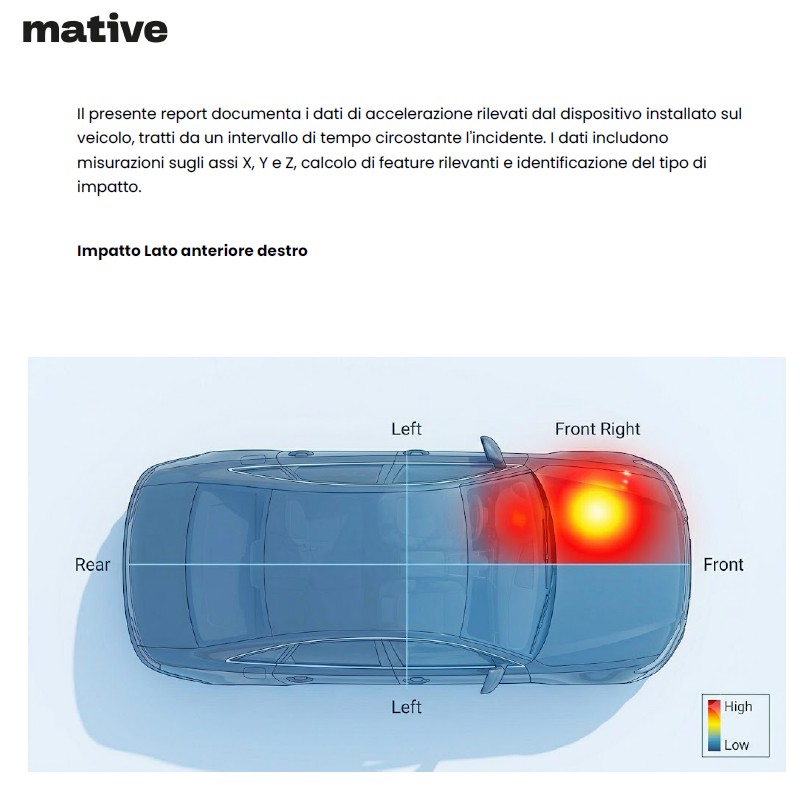
Example of an Automated Mative Report Summary: "Mative Cloud detected a high-energy structural anomaly. Our predictive model classified a severe impact localized on the front-right side of the vehicle. The force vector distribution suggests an oblique collision with a partially static obstacle during a turning maneuver."
A Game-Changer for Car Rental and Fleet Operations
Why is this technology developed by Mative so vital for vehicle operators?
- Eliminate Hidden Damage: Renters often return vehicles without mentioning minor collisions or structural impacts to lower components (like suspension arms or underbody shielding). With Mative, car rental operators know exactly if and where a vehicle suffered a blow during the rental period, enabling them to address damages with objective, digital proof at check-out.
- Minimize Vehicle Downtime: Knowing the exact side and severity of the impact immediately allows operators to order spare parts and schedule workshop repairs before the car even returns to the yard, optimizing fleet logistics and reducing lost revenue days.
- Fraud Prevention & Legal Protection: In disputed insurance cases, the Mative report provides an unalterable, scientific reconstruction of the crash physics. It is impossible to claim rear-end damage when sensors certify a front-end impact. This accelerates claims resolution and safeguards assets against fraudulent demands.
Telematics is no longer just about tracking physical locations; with Mative, it becomes a contextual understanding of asset health. The future of intelligent vehicle monitoring is here, and it is driven by data.